PALABRAS DE OFICINA EN INGLÉS Y ESPAÑOL

PALABRAS DE OFICINA EN INGLÉS Y ESPAÑOL:

Con esta lección aprenderás 15 palabras de oficina en inglés y español. Cada palabra está acompañada por una oración para que veas cómo se usa en contexto.

Haz clic en la imagen para ver el video:

palabras de oficina en inglés y español

GUÍA DE ESTUDIO: PALABRAS DE OFICINA EN INGLÉS Y ESPAÑOL

RESUMEN DE PALABRAS:

  • desk – escritorio
  • desk drawers – gavetas de escritorio
  • office chair – silla de oficina
  • adjustable office chair – silla de oficina ajustable
  • notebook – cuaderno
  • notebook tabs – pestañas del cuaderno
  • telephone / phone – teléfono
  • landline telephone – teléfono fijo
  • printer – impresora
  • printer ink – tinta de impresora
  • workplace – lugar de trabajo
  • book – libro
  • bookmark – separador / marcapáginas
  • binder – carpeta
  • copy machine – fotocopiadora
  • sticky notes – notas adhesivas
  • laptop – computadora portátil
  • desktop computer – computadora de escritorio
  • schedule – horario
  • USB flash drive – memoria USB
  • email – correo electrónico
  • send an email – enviar un correo electrónico
  • receive an email – recibir un correo electrónico
  • respond to an email – responder un correo electrónico

AUDIO DE LAS PALABRAS:

Escucha las palabras en inglés y español.

Si deseas puedes descargar el audio para seguir practicando las palabras nuevas.

ORACIONES:

Estas son las oraciones para que veas cómo se usan las palabras en contexto.

His desk is always messy.Su escritorio siempre está desordenado.
Her office chair is very uncomfortable.Su silla de oficina es muy incómoda.
He always keeps a notebook on his desk.Él siempre mantiene un cuaderno en su escritorio.
She’s in charge of answering the phone.Ella está a cargo de contestar el teléfono.
We need to buy more ink for the printer.Necesitamos comprar más tinta para la impresora.
A positive workplace culture is a priority for the manager.Una cultura positiva en el lugar de trabajo es prioridad para el gerente.
Our boss encouraged us to read a book every month.Nuestro jefe nos animó a leer un libro todos los meses.
All the documents are organized in binders.Los documentos están organizados en carpetas.
He had a hard time using the copy machine.A él le costó mucho usar la fotocopiadora.
She used sticky notes to plan the project.Ella usó notas adhesivas para planificar el proyecto.
He can work from anywhere with his laptop.Él puede trabajar desde cualquier lugar con su computadora portátil.
She got a promotion and a new desktop computer.Ella obtuvo un ascenso y una computadora de escritorio nueva.
Her schedule allows her to spend time with her daughters.Su horario le permite pasar tiempo con sus hijas.
All the clients’ files are saved in the USB flash drive.Todos los archivos de los clientes están guardadoes en la memoria USB.
It takes me two hours to respond to all my emails.Me toma dos horas responder a todos mis correos electrónicos.

SIGUE PRACTICANDO:

MIRA LA SERIE DE VOCABULARIO COMPLETA:

PASSIVE VOICE PAST CONTINUOUS TENSE

VIDEO:

Con este video aprenderás cómo usar PASSIVE VOICE PAST CONTINUOUS TENSE. La lección incluye 4 ejemplos, oraciones afirmativas, negativas y preguntas.

Haz clic en esta imagen para ver el video:

passive voice past continuous tense

GUÍA DE ESTUDIO: PASSIVE VOICE – PAST CONTINUOUS TENSE

EXAMPLES:

1.

Active Voice: I was using vegetables to make soup. | Yo estaba usando verduras para hacer sopa.

Passive Voice: Vegetables were being used to make soup. | Las verduras estaban siendo usadas para hacer sopa.

passive voice past continuous tense

2.

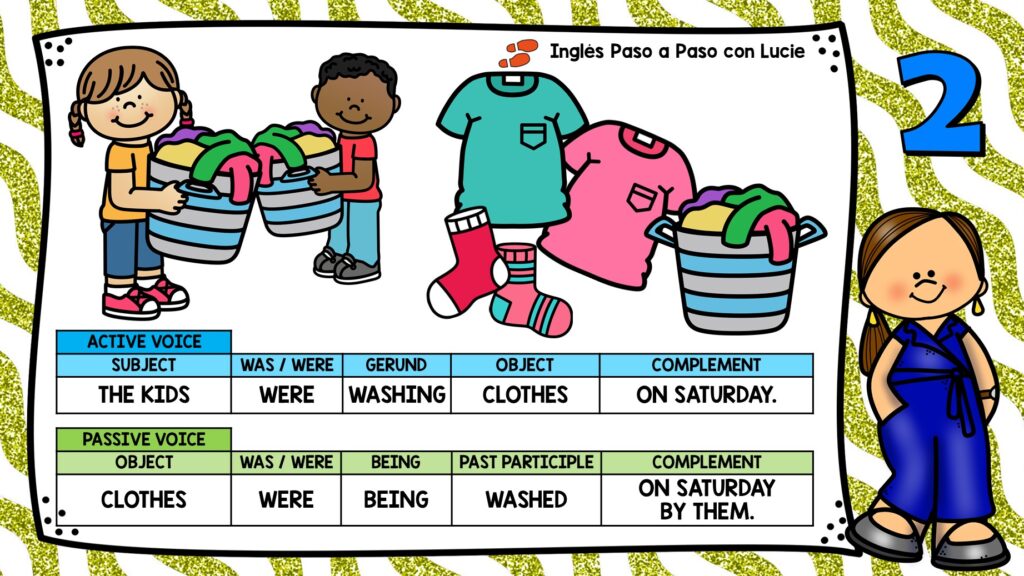
Active Voice: The kids were washing clothes on Saturday. | Los niños estaban lavando ropa el sábado.

Passive Voice: Clothes were being washed on Saturday. | La ropa estaba siendo lavada el sábado.

pasado continuo voz pasiva

3.

Active Voice: My daughter was selling hot chocolate in the park. | Mi hija estaba vendiendo chocolate caliente en el parque.

Passive Voice: Hot chocolate was being sold in the park. | Chocolate caliente estaba siendo vendido en el parque.

active and passive voice past continuous tense

4.

Active Voice: Students were wearing warm sweaters in December. | Los estudiantes estaban usando suéteres calientes en diciembre.

Passive Voice: Warm sweaters were being worn in December. | Suéteres calientes estaban siendo usados en diciembre.

past continuous tense change into passive voice

NEGATIVE SENTENCES: PASSIVE VOICE PAST CONTINUOUS TENSE

  1. Vegetables weren’t being used to make soup.
  2. Clothes weren’t being washed on Saturday.
  3. Hot chocolate wasn’t being sold in the park.
  4. Warm sweaters weren’t being worn in December.

QUESTIONS: PASSIVE VOICE PAST CONTINUOUS TENSE

  1. Were vegetables being used to make soup?
  2. Were clothes being washed on Saturday?
  3. Was hot chocolate being sold in the park?
  4. Were warm sweaters being worn in December?

SIGUE PRACTICANDO:

ACTIVE VOICE PAST CONTINUOUS TENSE:

Con esta explicación del Pasado Continuo en inglés aprenderás:

  • Oraciones Afirmativas: Affirmative Sentences
  • Oraciones Negativas: Negative Sentences
  • Contracciones: Contractions
  • Preguntas de sí o no: Yes / No Questions
  • Respuestas cortas: Short Answers
  • Preguntas con WH: Information Questions

PASADOS PARTICIPIOS:

Aprende a usar el Pasado Participio en inglés. En esta lección te comparto el listado de verbos irregulares en inglés.

REGLAS DEL ING – CÓMO FORMAR UN GERUNDIO EN INGLÉS:

Con esta lección aprenderás las reglas del ING que te van a servir muchísimo cuando deletrees un gerundio.

SERIE DE LA VOZ PASIVA EN INGLÉS:

A continuación podrás encontrar las lecciones de la voz pasiva que he hecho hasta ahora. Estas son la base para poder usar Passive Voice Past Continuous tense.

PASSIVE VOICE – SIMPLE PRESENT TENSE

PASSIVE VOICE – SIMPLE PAST TENSE:

PASSIVE VOICE – PRESENT CONTINUOUS TENSE:

EXPLICACIÓN DE LAS PARTES DE UNA ORACIÓN EN INGLÉS

VIDEO:

En esta lección te comparto la explicación de las partes de una oración en inglés.

Vamos a aprender el uso de un sustantivo, adjetivo y verbo.

Haz clic en esta imagen para ver el video:

explicación de las partes de una oración en inglés

GUÍA DE ESTUDIO: EXPLICACIÓN DE LAS PARTES DE UNA ORACIÓN EN INGLÉS

SIGUE PRACTICANDO:

A continuación encontrarás las lecciones de las partes de una oración enfocadas en las diferentes estaciones y épocas del año. Aprenderás vocabulario y el uso de los sustantivos, adjetivos y verbos en inglés.

EXPLICACIÓN DE LAS PARTES DE UNA ORACIÓN – PRIMAVERA

EXPLICACIÓN DE LAS PARTES DE UNA ORACIÓN – VERANO:

EXPLICACIÓN DE LAS PARTES DE UNA ORACIÓN – OTOÑO:

EXPLICACIÓN DE LAS PARTES DE UNA ORACIÓN – INVIERNO:

EXPLICACIÓN DE LAS PARTES DE UNA ORACIÓN – NAVIDAD:

WHAT IS A NOUN? – ¿QUÉ ES UN SUSTANTIVO?

A noun is a person, an animal, an object or a place.

Un sustantivo es una persona, un animal, un objeto o un lugar.

Ejemplos de sustantivos:

  • teddy bear – oso de peluche
  • chocolate box – caja de chocolates
  • cupcake – pastelito
  • envelope – sobre
  • gift / present – regalo
  • locket – relicario

WHAT IS AN ADJECTIVE? – ¿QUÉ ES UN ADJETIVO?

An adjective describes a noun.

Un adjetivo describe a un sustantivo.

Ejemplos de adjetivos:

  • colorful – colorido
  • cuddly – cariñoso (que le gusta dar y recibir abrazos)
  • cute – lindo
  • huge – enorme
  • flirty – coqueta
  • shy – tímida
  • soft – suave
  • tasty – sabroso

WHAT IS A VERB? – ¿QUÉ ES UN VERBO?

A verb is an action.

Un verbo es una acción.

Ejemplos de verbos:

  • blush – ruborizarse
  • dance – bailar
  • dream – soñar
  • eat – comer
  • give – dar / regalar
  • hug – abrazar
  • kiss – besar
  • make – hacer
  • open – abrir
  • share – compartir
  • talk – hablar

INGLÉS PARA VIAJAR EN AVIÓN

VIDEO: INGLÉS PARA VIAJAR EN AVIÓN

Con esta lección aprenderás preguntas en inglés para viajar en avión.

Estas son algunas de las preguntas que puedes hacer en un aeropuerto.

Haz clic en la imagen para ver el video:

inglés para viajar en avión

GUÍA DE ESTUDIO – INGLÉS PARA VIAJAR EN AVIÓN

PREGUNTAS EN INGLÉS PARA VIAJAR EN AVIÓN:

Te comparto el resumen de esta lección. Puedes practicar las preguntas en inglés junto con su traducción.

  1. Where’s the check-in counter for Copa Airlines? – ¿Dónde está el mostrador de facturación de Copa Airlines?
  2. Is my flight on time? – ¿Mi vuelo está a tiempo?
  3. How long is my flight delayed? – ¿Cuánto tiempo se demora mi vuelo?
  4. Where’s the bathroom? Where’s the restroom? – ¿Dónde está el baño?
  5. Where’s the internet lounge? – ¿Dónde está la sala de internet?
  6. Where’s the smoking lounge? – ¿Dónde está el salón de fumadores?
  7. Can I get a window seat? – ¿Puedo conseguir un asiento junto a la ventana?
  8. Can I get an aisle seat? – ¿Puedo conseguir un asiento en el pasillo?
  9. Where can I find a taxi? Where can I find a cab? – ¿Dónde puedo encontrar un taxi?
  10. Where can I find a bus? – ¿Dónde puedo encontrar un autobus?
  11. Where’s the baggage claim? – ¿Dónde está el reclamo de equipaje?
  12. Where’s the departure gate? – ¿Dónde está la puerta de salida?
  13. When should I be at the departure gate? – ¿Cuándo debería estar en la puerta de salida?
  14. Is our connecting flight on time? – ¿Nuestro vuelo de conexión llega a tiempo?

SIGUE PRACTICANDO: PREGUNTAS DE TRANSPORTE Y VIAJE

Con esta lección aprenderás 22 preguntas en inglés y español para que puedas sostener una conversación relacionada con transporte.

MIRA LA SERIE COMPLETA DE PREGUNTAS:

Con esta serie podrás aprender preguntas que puedes usar en tus conversaciones diarias. Usualmente nos enfocamos en responder las preguntas que nos hacen, pero cuando sabes preguntas claves de diferentes temas, tus conversaciones resultan mucho más fáciles.

EXPRESIONES DE CONVERSACIÓN EN INGLÉS Y ESPAÑOL

VIDEO:

Sigamos aprendiendo expresiones de conversación en inglés y español. Hoy nos vamos a enfocar en cómo usar la expresión ALL IN ALL.

Haz clic en la imagen para ver el video:

expresiones de conversación en inglés y español

GUÍA DE ESTUDIO:

SIGUE PRACTICANDO:

MIRA LA SERIE COMPLETA DE EXPRESIONES EN INGLÉS:

ACTIVIDADES DE TIEMPO LIBRE EN INGLÉS

PARTE 2:

Con este video aprenderás actividades que puedes hacer en tu tiempo libre. La lección incluye pasatiempos, oraciones con ejemplos, práctica de vocabulario y pronunciación.

Haz clic en la imagen para ver el video:

actividades de tiempo libre en inglés

GUÍA DE ESTUDIO:

SIGUE PRACTICANDO:

MIRA LA SERIE COMPLETA DE VOCABULARIO:

PASSIVE VOICE PRESENT CONTINUOUS TENSE

VIDEO:

Con este video aprenderás cómo usar PASSIVE VOICE – PRESENT CONTINUOUS TENSE. La lección incluye 4 ejemplos, oraciones afirmativas, negativas y preguntas.

Haz clic en la imagen para ver el video:

passive voice present continuous tense

GUÍA DE ESTUDIO:

SIGUE PRACTICANDO:

MIRA LA SERIE COMPLETA DE PASSIVE VOICE:

SERIE COMPLETA DE GRAMÁTICA:

CÓMO DESCRIBIR UNA IMAGEN EN INGLÉS

VIAJE DE CAMPAMENTO:

Con esta lección aprenderás cómo describir una imagen en inglés relacionada con un viaje de campamento.

La lección incluye palabras nuevas, oraciones, y práctica de pronunciación.

Haz clic en la imagen para ver el video:

cómo describir una imagen en inglés

GUÍA DE ESTUDIO:

SIGUE PRACTICANDO:

QUÉ SIGNIFICA AS A MATTER OF FACT

FRASES EN INGLÉS Y ESPAÑOL: AS A MATTER OF FACT

¿Qué significa AS A MATTER OF FACT? Hoy vamos a aprender el significado de esta expresión común en inglés.

La lección incluye:

  • Ejemplos
  • Traducción en inglés y español
  • Práctica de pronunciación
  • Variaciones

Haz clic en esta imagen para ver el video:

qué significa as a matter of fact

GUÍA DE ESTUDIO:

SIGUE PRACTICANDO:

MIRA LA SERIE COMPLETA DE EXPRESIONES: